Showing posts with label Military. Show all posts

Tuesday, April 02, 2024

Slavery Refresher, Barbary Pirates Edition


We’ve all heard about Barbary Pirates, but other than the U.S. Marines defeating them in the early 1800s, what do we really know about that era?

Well, it lasted over 300 years, from 1500-1815 more or less, and during that time the Barbary Pirates captured lots of loot but also lots of people and either enslaved them or sold them into slavery.

One historian estimates that 1.5 million Europeans were enslaved in this way. The slave trade was a thriving business.

Did you know that Barbary Pirates raided towns as far away as Ireland to capture slaves? Neither did I.

And if you’ve ever heard the term “galley slave” but were unsure exactly what that means, well … you won’t be unsure any more. Think about living that life next time you’re having a bad day. The phrase “hell on earth” seems pretty close.


Slavery was not just common throughout the world for thousands of years, it was a major source of revenue for many of the richest people.

It was not invented in America in 1619.


Thursday, February 22, 2024

Two of My All-Time Favorite People Born on This Day: George Washington and …


… My Wife! Happy Birthday my love!

As for the George Washington part…

Fun Fact: he kinda sorta started the French-Indian War in 1754, which morphed into the Seven Years War in 1756, a global conflict, that led indirectly to the same oppressive taxation by the Brits on the American colonies, which subsequently led directly to the American Revolution. 


Monday, February 19, 2024

FDR Issues Executive Order 9066 on Feb 19, 1942


Later known as “Japanese Internment Camps” 

However, strangely enough, there is no language in the order itself specifying the Japanese or any other ethnic group. From archives.org:

The West Coast was divided into military zones, and on February 19, 1942, President Franklin D. Roosevelt issued Executive Order 9066 that authorized military commanders to exclude civilians from military areas. Although the language of the order did not specify any ethnic group, Lieutenant General John L. DeWitt of the Western Defense Command proceeded to announce curfews that included only Japanese Americans.

Reading further reveals it was not Roosevelt but DeWitt who turned what was a generic “exclude civilians from military areas” order into an “imprison 122,000 people, 70,000 of them citizens” order. 

General DeWitt first encouraged voluntary evacuation by Japanese Americans from a limited number of areas. About seven percent of the total Japanese American population in these areas complied. Then on March 29, 1942, under the authority of Roosevelt's executive order, DeWitt issued Public Proclamation No. 4, which began the forced evacuation and detention of Japanese-American West Coast residents on a 48-hour notice. Only a few days prior to the proclamation, on March 21, Congress had passed Public Law 503, which made violation of Executive Order 9066 a misdemeanor punishable by up to one year in prison and a $5,000 fine.

In the next six months, approximately 122,000 men, women, and children were forcibly moved to "assembly centers." They were then evacuated to and confined in isolated, fenced, and guarded "relocation centers," also known as "internment camps." The 10 sites were in remote areas in six western states and Arkansas: Heart Mountain in Wyoming, Tule Lake and Manzanar in California, Topaz in Utah, Poston and Gila River in Arizona, Granada in Colorado, Minidoka in Idaho, and Jerome and Rowher in Arkansas.

Nearly 70,000 of the evacuees were American citizens. The government made no charges against them, nor could they appeal their incarceration. All lost personal liberties; most lost homes and property as well. Although several Japanese Americans challenged the government’s actions in court cases, the Supreme Court upheld their legality.

Well, that’s pretty much how that’s going to work when, 3 months after Pearl Harbor, you designate the Secretary of War to decide how to enforce such broad new powers. His goal is to run the war, and now you gave him carte blanche to strip rights from citizens. And then he delegates that power to a Lieutenant General in the Western Defense Command.

Was it legal? Not exactly. But Lincoln suspended habeus corpus during the Civil War. That wasn’t “legal”, exactly. 

Wartime tends to muddy the waters on what is strictly legal and what is not. 

And it’s not like this attack on Japanese ethnics came out of nowhere. California led the way (as a result of the Gold Rush of 1848 and completion of the Trans-Continental railroad in 1869 both of which brought many Chinese into the area) with anti-Chinese sentiment leading to the Chinese Exclusion Act of 1882, a federal law prohibiting any further such immigration for ten years — and was subsequently renewed several times. 

Later, California passed the California Alien Land Law of 1913 which prohibited “aliens ineligible for citizenship from owning agricultural land or possessing long term leases of it”, targeting primarily Japanese farmers after an influx of indentured servants from Hawaii in 1900. It was overturned in 1952 by the U.S. Supreme Court as a violation of the equal protection clause of the 14th Amendment.

There was plenty of public support for anti-Asian discrimination, in other words. These examples are just scratching the surface. 

A map from the National Park Service site showing the locations and max populations of the camps.

Thursday, February 09, 2023

European History Leading Up to WWI


It’s a giant mess, and that explains a lot

The usual explanations for the causes of World War I — alliances and imperialism — can be confusing because they stop well short of the full set of conditions that led up to the sudden outbreak of war in Summer 1914. 

It always sounded strange to me, probably because like most people in this day and age, and until I started digging into this on my own over the last couple of years, I had no real concept of the level of European chaos and conflict — especially the ruling class vs the ruled, and between ethnic groups — that fed a constant system of discontent for centuries, creating a powder keg ready to erupt at any time. 

One of the biggest players in the late 19th century was the Austro-Hungarian Empire, which also serves as a good example of the kind of ever-present ethnic and tribal conflict and ruling class power struggles that has always defined Europe.

Keep in mind, this was known as the “civilized” world.


Austro-Hungarian Empire 1848 - 1922 


Layered on top of that, this mess of international alliances and protection of global imperialist interests.


The First World War and International Relations 1900 - 1920


Monday, June 06, 2022

Monday, May 30, 2022

Taking Chance


Memorial Day reminds us of sacrifice and so today would be the perfect day to watch this  great movie, “Taking Chance”.

Here’s the trailer: Taking Chance trailer

A true story about a young man Chance Phelps who died much too young and the Marine who volunteers to escort the body back home to Wyoming for burial. 

It began as a wonderful and touching human interest story “Taking Chance Home” written by LtCol Michael Strobl USMC, posted at a military blog that I read regularly back in 2004 called blackfive.net.

I saw “Taking Chance” upon its release in 2009 and then again on Saturday and it has lost none of its emotional power.

There were many movies made about our adventures and mis-adventures in Iraq and Afghanistan but most were manipulative and exploited death to hammer home political points. That’s gross.

But if you like raw and emotionally powerful stories told well, about honoring sacrifice, with characters you quickly grow to like and respect, you’ll not do better than this one.

A scene that did not make it into the movie but is excellent nonetheless.


PFC Chance Phelps was posthumously awarded the Bronze Star and promoted to Lance Corporal.

Here’s the real Lt Col Strobl discussing the making of the movie.


Free on HBO Max and you can rent it on Amazon. 

Tuesday, May 24, 2022

Paying Tribute


The Changing of the Guard at the Tomb of the Unknown Soldier is a solemn and important ritual and one of the few “must see” events in my life, and that’s been true for over 50 years since I saw it for the very first time as a kid age 10-11.

One of my favorite podcasts, The American Story, explains why it matters in this week’s excellent episode Known But to God

My advice: take 6 minutes out of your life to nourish your soul. You’ll be glad you did.


Tuesday, April 12, 2022

What is Juneteenth?


The U.S. government declared “Juneteenth” a new federal holiday in 2021 to commemorate June 19, 1865 when Union forces ordered Confederate dead-enders on the remote western frontier in Texas to enforce the Emancipation Proclamation, i.e. the abolition of slavery in former slave states.

For symbolic meaning I would suggest that a far more important date in history would be April 9, 1865 when Gen. Robert E. Lee and the Army of Northern Virgina surrendered at Appomattox, because that day changed the course of history as the clear “before vs. after” date that history pivots on. The Civil War was over — although it took several weeks for other generals of other state armies in the field to stop fighting, but that’s the nature of wars in the 19th century, well before Twitter.

That day ended 4 years of an ugly brutal war that split apart families, villages, regions and states with a level of red-hot violence and hatred that led directly to the assassination of President Lincoln just five days later. It was pivotal in American history — and in world history too. 

But it wasn’t really over, despite 600,000 war dead and a fractured society, because it took another 100 years to address the more intractable issue: institutionalized racism in the halls of power, especially the federal and southern state governments.

The list of ways that the U.S. Supreme Court in particular, along with the various southern state governments, dug in their heels against treating blacks like human beings is long, varied and painful to review, and even worse, stretches well over a century.

Three examples to illustrate the point.

(1) 

Dred Scott vs Sandford in 1857 declared that all persons of African descent — not just slaves — are not entitled to any rights that citizens enjoy, by definition:

“… are not included, and were not intended to be included, under the word 'citizens' in the Constitution, and can therefore claim none of the rights and privileges which that instrument provides for and secures to citizens of the United States”

Well. Good to know. Here’s a good video explaining why the decision was so epically awful. 


(2)

The Reconstruction amendments (13th, 14th, and 15th) in the postwar years 1865-70, specifically the Citizenship Clause of the 14th, were intended to restate the founding principles of the country and overcome wrong-headed decisions like the above — but went unenforced and essentially ignored in southern states where they were needed the most. Who has Constitutional oversight to force states to comply with federal law? The Executive Branch of the federal government. But they did nothing, probably because there was in fact no real way to enforce federal law at that time.

(3)

Plessy vs Ferguson — settled in 1896, over 30 years after the end of the Civil War — could have put all that to rest but chose instead to enshrine the caste system of “separate but equal” as settled law. This single decision ratified the “Jim Crow laws” era and set the course for almost 70 more years of enforced segregation.

It was not until 1954 that segregation and “separate but equal” were finally recognized as illegal with “Brown vs. Board of Education” — but even that was not enough to pull the dead-enders forward into the 20th century, leading to the Civil Rights Act of 1964 and the Voting Rights Act of 1965.

So it took 100 more years after the war ended to accomplish what the Emancipation Proclamation set out to do.

Juneteenth as a holiday makes sense, perhaps, as a Texas day of remembrance — and was declared a state holiday for that purpose in 1980. 

But as a national holiday? 

The days we choose to memorialize as a culture become the stories we tell in the future, and it’s not really that I’m against telling the Juneteenth story as much as I’m wondering who’s going to tell the story about government denying rights to black people for another 100 years. That’s the story that needs telling.

For completeness here is the actual text of the order of June 19, 1865.

Head Quarters District of Texas
Galveston Texas June 19th 1865.
General Orders
No. 3.

The people of Texas are informed that, in accordance with a proclamation from the Executive of the United States, all slaves are free. This involves an absolute equality of personal rights and rights of property between former masters and slaves, and the connection heretofore existing between them becomes that between employer and hired labor.

The freedmen are advised to remain quietly at their present homes and work for wages. They are informed that they will not be allowed to collect at military posts and that they will not be supported in idleness either there or elsewhere.

By order of Major General Granger

Saturday, April 09, 2022

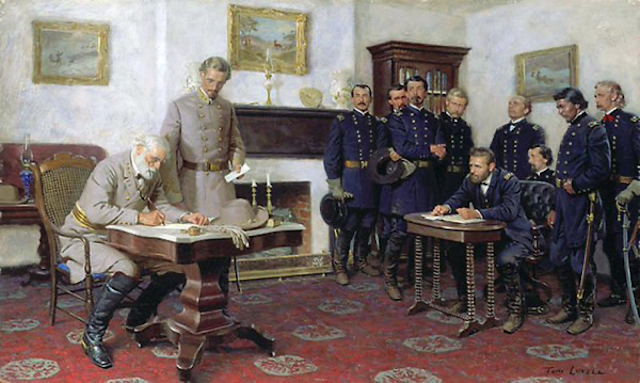
Today in 1865: Gen. Robert E. Lee Surrenders, Ending U.S. Civil War


History.com explains.

In retreating from the Union army’s Appomattox Campaign, the Army of Northern Virginia had stumbled through the Virginia countryside stripped of food and supplies. At one point, Union cavalry forces under General Philip Sheridan had actually outrun Lee’s army, blocking their retreat and taking 6,000 prisoners at Sayler’s Creek. Desertions were mounting daily, and by April 8 the Confederates were surrounded with no possibility of escape. On April 9, Lee sent a message to Grant announcing his willingness to surrender. The two generals met in the parlor of the Wilmer McLean home at one o’clock in the afternoon.

Note the extremely generous terms of surrender:

Lee asked for the terms, and Grant hurriedly wrote them out. All officers and men were to be pardoned, and they would be sent home with their private property–most important, the horses, which could be used for a late spring planting. Officers would keep their side arms, and Lee’s starving men would be given Union rations.

Grant said “[The Rebels] were now our countrymen. We did not want to exult over their downfall”.

It’s very apparent from reading Grant’s account of the surrender in his memoirs that his immense respect for General Lee and their shared West Point heritage got in the way here:

… I felt like anything rather than rejoicing at the downfall of a foe who had fought so long and valiantly, and had suffered so much for a cause, though that cause was, I believe, one of the worst for which a people ever fought, and one for which there was the least excuse. I do not question, however, the sincerity of the great mass of those who were opposed to us ...

We soon fell into a conversation about old army times. He remarked that he remembered me very well in the old army; and I told him that as a matter of course I remembered him perfectly, but from the difference in our rank and years (there being about sixteen years' difference in our ages), I had thought it very likely that I had not attracted his attention sufficiently to be remembered by him after such a long interval. Our conversation grew so pleasant that I almost forgot the object of our meeting. After the conversation had run on in this style for some time, General Lee called my attention to the object of our meeting, and said that he had asked for this interview for the purpose of getting from me the terms I proposed to give his army.

Five days later President Lincoln was assassinated. Grant won two terms as president starting in 1868 and was a key leader in the Reconstruction effort, which Johnson (Lincoln’s vice president) had resisted.

I’m a little surprised that this day is not more widely known, remembered, and commemorated since the U.S. Civil War was one of the bloodiest and ugliest wars in our history. 

Thursday, March 31, 2022

Napoleon’s Invasion of Russia: On the All-Time List of Military Disasters


Near the Top, I Think

As we all know by now, invading Russia just never works out. But in 1812 Napoleon had yet to try it, he was undefeated for nearly 20 years, and besides, he was Napoleon.

But mainly he was pissed at Czar Alexander II for withdrawing from a trade blockade against the British and decided it was a good idea to invade a gigantic country with the largest army ever assembled to that time, 500,000 men, planning to quickly overwhelm the Russians with that huge army and force Alexander to the bargaining table. 

And waiting until late June to get started.

That plan did not work out. See if you can guess why.

The Russians, like Muhammad Ali vs. George Foreman in the 1974 “Rumble in the Jungle”, used a rope-a-dope strategy, retreating and luring Napoleon’s Grand Armee deeper and deeper into the interior of Russia as the calendar advanced, abandoning cities and burning all the crops and supplies to starve and demoralize enemy forces.

All the way to Moscow, which they also burned. 

By now it’s September. Tick, tock.

Napoleon waited in Moscow several weeks for a surrender that never came, and by then it was the middle of October and the French were forced to retreat with no way to survive the winter. 


But it was already far too late, and the retreat was horrific, with a starving and exhausted army, an early and cold winter, aggressive counter-attacks by Russian forces during the retreat, and no food or supplies to be found along the way. 

By late November it was chaos, every man for himself. Tens of thousands deserted, the wounded left behind. They resorted to stacking dead bodies to block the wind and crawling inside the carcasses of dead horses for warmth.

Only 100,000 returned to France, the other 400,000 - 500,000 troops dead, deserted, left behind, or captured. 

In the annals of military disasters, this one is way up there near the top. Hitler would learn it all over again at the Battle of Stalingrad in 1942-3.

Links

Wednesday, March 30, 2022

Today in 1814: Napoleon Defeated, Paris Falls


One of the most fascinating people in history, by 1807 Napoleon had conquered, annexed or strong-armed nearly all of Europe.

Shrewd and ambitious, he took advantage of the chaos after the French Revolution:  promoted all the way to commander of the entire French military at 26, and ran a successful coup to run the country at 30 in 1799. 

He fought more battles than Alexander the Great and Julius Caesar combined, according to the Why Napoleon? page at the Napoleonic Historical Society, calling him “the most famous self-made man in history”, and they make a good case for it.

I recommend reading the Napoleon page at history.com and watching the short and entertaining video at the top to get a good summary of his impressive accomplishments away from the battlefield too: leading the country out of chaos, building Paris into a beautiful city of parks and boulevards, creating the French banking system and setting up a “fair and modern” legal code that’s still in use today.

But he was headed straight for the rocks in a major way.

Starting in 1812 his armies suffered a string of crushing defeats — the first and the worst, by far, was the disastrous and infamous invasion of Russia in 1812 (more on that soon). Then in 1813 after other nation-states saw an opportunity and joined together to fight his forces, he lost decisively at the Battle of Leipzig. By March 30, 1814, those enemy forces marched into Paris and Napoleon abdicated. 

In less than two years he went from the most powerful ruler in the world to isolated, shamed and defeated. 

The next 15 months were, um, interesting. In April 1814 he was exiled to Elba, a tiny island in the Mediterranean — but escaped with the help of 1,000 supporters and returned to Paris triumphant in March 1815, at which time Britain, Austria, Prussia, and Russia began to prepare for war. So Napoleon raised an army and by June he invaded Belgium but suffered another epic defeat in June at Waterloo, whereupon he was handed over to the Brits and they exiled him again, this time to St Helena in the middle of the Atlantic Ocean.

He died there in 1821.

Links


Monday, March 07, 2022

Remembering Prussia


No, not Russia … Prussia

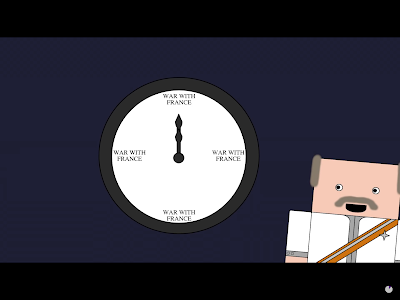
Here's another entertaining video from History Matters — I laughed out loud a couple times at the graphics, especially the clock with "War With France" at every hour — about how Prussia just sort of evaporated away over the course of several decades from the 1860s through 1932.


"If you look at the clock you'll see that it's time for War With France" …


So as with all of European history this story is insanely complicated, chopped up into little fiefdoms, duchies, territories, and kingdoms with cultural borders that sometimes match sovereign borders and sometimes do not. Never-ending war is the obvious result, and that's what they had.

The two most well-known Prussian leaders from that time, at least to me, were Otto von Bismarck and Carl von Clausewitz.

Clausewitz of course is one of the most famous military strategists in history responsible for the saying "war is politics by other means" plus many other advancements in military theory. From Wikipedia:

He stressed the dialectical interaction of diverse factors, noting how unexpected developments unfolding under the "fog of war" (i.e., in the face of incomplete, dubious, and often completely erroneous information and high levels of fear, doubt, and excitement) call for rapid decisions by alert commanders. He saw history as a vital check on erudite abstractions that did not accord with experience. In contrast to the early work of Antoine-Henri Jomini, he argued that war could not be quantified or reduced to mapwork, geometry, and graphs. Clausewitz had many aphorisms, of which the most famous is "War is the continuation of politics by other means."

"Fog of war" requiring rapid decisions by alert commanders ... history as a vital check on erudite abstractions that do not accord with experience ... war cannot be quantified or reduced to mapwork, geometry, and graphs ... yep, that all checks out.

He was way, way ahead of his time, and is at least one key reason that Prussia has the reputation of having been an advanced military power.

Otto von Bismarck presided over the unification of Germany in 1871 after the Franco-Prussian War and served as Chancellor of that newly-unified state until his death in 1890, leading the continent politically during that time. 

Bismarck's diplomacy of Realpolitik and powerful rule at home gained him the nickname the Iron Chancellor. German unification and its rapid economic growth was the foundation to his foreign policy. He disliked colonialism but reluctantly built an overseas empire when it was demanded by both elite and mass opinion. Juggling a very complex interlocking series of conferences, negotiations and alliances, he used his diplomatic skills to maintain Germany's position.

A 19th century European leader who disliked colonialism and had to be pushed into it … imagine that. 

Also, a question:  is it possible that having one strong, skillful, diplomatic leader like Bismarck to guide a place like Europe — a violent chaotic mess for centuries — is a better bet than the NGO system that followed after WWI? Something to ponder.

European history fascinates me, with all the intermarried royalty and competing ethnic tribes and the Pope and constant war and evolving borders and a near-total lack of any kind of rights for citizens or even the idea of “citizen”. Growing up in America in the late 20th century, it seems nearly impossible to envision what life was like for people forced to live under those conditions, and serves as a reminder that we should be careful what we wish for when we demand “progress”.

History Matters has another video on the early history of Prussia from it’s start in 1525 that I will cover in the next couple of weeks.

Tuesday, March 01, 2022

“Getting Fooled Again” is a Pattern, Unfortunately


“Won’t Get Fooled Again” is an anthem for people who decide not to Buy The Bullshit any more.


Governments around the world and throughout human history specialize in using lies to justify war and — of course — send everyone else’s kids, husbands and wives, and brothers and sisters to fight it. It’s not quite important enough for them to have any skin in the game, you see. 

After several iterations over a few decades of this, you’ve heard it all before and just don’t want to play that game — Buy The Bullshit — any more. 

Especially when the “news” you read and see and hear is crafted and filtered and massaged and censored to create a narrative, i.e., it’s a sales job, 100%. Believe it if you like, but never assume you’re hearing anything close to Truth.

I'll tip my hat to the new constitution
Take a bow for the new revolution
Smile and grin at the change all around
Pick up my guitar and play
Just like yesterday
Then I'll get on my knees and pray
We don't get fooled again

An excellent example of getting fooled again was the Tet Offensive in January-February 1968 when the Viet Cong (Communist-backed guerilla fighters in the South) plus North Vietnamese regulars launched their biggest offensive of the entire Vietnam War against all of the biggest cities in South Vietnam including Saigon and Hue plus several military bases. 

The Tet Offensive took the U.S. and South Vietnamese forces by surprise — because the ground war prior to that had been fought mostly in the jungle and countryside — and as a result the VC captured most of these targets on the first day, but within a few days all cities except Hue were recaptured. Hue was the last to be recaptured, on February 24, less than 4 weeks after the start of Tet.

As a military operation it was a colossal failure for the Communists: they suffered 10x the casualties (approximately 100,000 total killed, wounded, captured, or missing) and captured no territory, and failed to achieve the primary goal of igniting a popular uprising in the South. 

But it did achieve an even bigger, more strategic and completely unanticipated goal in the U.S.: a relentless stream of slanted “bad” news for Walter Cronkite, the most trusted man in America, and the rest of the U.S. media to cover every night — especially since the embedded journalists spent nearly all their time in those same targeted cities which had appeared peaceful before Tet due to the guerilla war fought mainly in the jungle. 

Suddenly their world was on fire — to be expected when covering war — and they told that story effectively but neglected to tell the “all is peaceful again and the Communists suffered an epic defeat” story less than 4 weeks later.

This inaccurate coverage did two hugely important things:  (1) it drove popular opinion decisively against the war, causing President Johnson just a few weeks later to drop out of the presidential contest in November as an incumbent, and (2) as a result the North Vietnamese changed their strategy to inflict maximum casualties so that the American news media would propagandize for them every night, changing hearts and minds with bloody, depressing pictures and video. 

To this day the Tet Offensive is incorrectly seen as a big military victory that swung the war, when in fact it was a big military loss that was spun into a public relations victory by an actively “on the other side” U.S. media.

Over the next few months the country was rocked by one crisis after another. In early April Martin Luther King Jr was assassinated. In early June, after winning the California primary and on a glide path to the nomination and very likely election victory, Robert Kennedy Jr was assassinated. In August the Democratic Convention became a violent, out-of-control riot in the streets, mostly driven by SDS subversives who were the major force in the anti-war movement as well. 

We will never know for sure, but it’s interesting to ponder how the rest of that year, and the decades to follow, might have unfolded differently if not for that one factor that seemed to start it all:  spinning the Tet Offensive military victory into a defeat.

Considered against the backdrop of this story plus hundreds like it, “pickup my guitar and play just like yesterday” and then deciding not to get fooled again sounds like pretty good advice.

Saturday, February 19, 2022

This Week in Military History, Barbary Wars 1804 Edition


During the Barbary Wars in the early 1800s the U.S. Navy — tired of American merchant ships and cargo seized by pirates who enslaved and held their crews for exorbitant ransom, and fearing strategic disadvantage with the capture in 1803 of a newer and more advanced Navy warship — did something incredibly daring about it

In October 1803, the U.S. frigate Philadelphia ran aground near Tripoli and was captured by Tripolitan gunboats. The Americans feared that the well-constructed warship would be both a formidable addition to the Tripolitan navy and an innovative model for building future Tripolitan frigates. Hoping to prevent the Barbary pirates from gaining this military advantage, Lieutenant Stephen Decatur led a daring expedition into Tripoli harbor to destroy the captured American vessel on February 16, 1804.

After disguising himself and his men as Maltese sailors, Decatur’s force of 74 men, which included nine U.S. Marines, sailed into Tripoli harbor on a small two-mast ship. The Americans approached the USS Philadelphia without drawing fire from the Tripoli shore guns, boarded the ship, and attacked its Tripolitan crew, capturing or killing all but two. After setting fire to the frigate, Decatur and his men escaped without the loss of a single American. The Philadelphia subsequently exploded when its gunpowder reserve was lit by the spreading fire.

Hugely successful — you simply cannot be any more successful than that.

Lt. Decatur was quickly becoming a national hero, and is still to this date the youngest person ever promoted to Captain in the history of the U.S. Navy.

Decatur supervised the construction of several U.S. naval vessels, one of which he later commanded. Promoted at age 25, he is the youngest man to reach the rank of captain in the history of the United States Navy. He served under three presidents, and played a major role in the early development of the U.S. Navy. In almost every theater of operation, Decatur's service was characterized by acts of heroism and exceptional performance. His service in the U.S. Navy took him through both Barbary Wars in North Africa, the Quasi-War with France, and the War of 1812 with Britain. He was renowned for his natural ability to lead and for his genuine concern for the seamen under his command. His numerous naval victories against Britain, France and the Barbary states established the United States Navy as a rising power. ... Decatur emerged as a national hero in his own lifetime, becoming the first post-Revolutionary War hero. His name and legacy, like that of John Paul Jones, became identified with the United States Navy.

At a hugely important time in American history, with a new and yet-to-be established Navy and seafaring reputation, this kind of leadership is exactly what was needed.

A map of the Barbary Coast region for visual context.


“To the shores of Tripoli” in the US Marines Hymn refers to these Barbary Wars.

Capt. Decatur was killed in 1820 at just 41 years of age in a duel with a Commodore Barron, who demanded that Decatur retract remarks he made as an officer presiding over Barron’s court-martial and later about Barron’s conduct during the Chesapeake-Leopard affair in 1807, one of the events that led to the War of 1812. It’s worth reading more, but to summarize, Barron as commander of the USS Chesapeake during the incredibly chaotic Napoleonic Wars was unprepared for battle when confronted by a British Royal Navy ship looking for deserters on board, and surrendered after firing just once. The incident enraged the public in the U.S., both because of apparent U.S. Navy vulnerabilities and a lack of respect from the British in the incident’s aftermath. 

Wednesday, December 08, 2021

Stories We Need to Tell: Pearl Harbor

Yesterday was December 7th, the 80th anniversary of the Japanese attack on Pearl Harbor.

Today is December 8th, the 41st anniversary of the murder of John Lennon by a deranged fan.

One of the best measures of a culture is how well it passes stories from generation to generation that revere those who came before, especially those who died heroically doing something bigger than themselves. 

Do parents and teachers instruct every schoolchild on these events and the heroes that died doing something bigger than themselves? 

Do those kids grow up holding these stories close to their hearts, knowing that it’s their job to pass them on to their own kids? 

Does the wider culture reinforce these stories with poems, books, essays, music, movies, etc.?

With Pearl Harbor, I don’t see much of any of that happening.

As a culture we seem more focused on the murder of a former Beatle than on one of the worst military disasters in our history. Yes, Pearl Harbor was 80 years ago, but that’s irrelevant, because cultural stories become more important over the years, not less. 

This is part of the problem:  we are far too focused on the recent past at the expense of the distant past. That’s a good way to lose track of who we are as a people. We must keep close to our hearts those things that really matter to our survival as a people and as a culture.

Culture must be viewed as a living, breathing thing that needs care and attention or it will die. If few people know who and what came before them, they have no culture or history to speak of, and will commence to dishonor all of it. It’s happening right now, in fact.

The grim details of the attack:

The base was attacked by 353 Imperial Japanese aircraft (including fighters, level and dive bombers, and torpedo bombers) in two waves, launched from six aircraft carriers. Of the eight U.S. Navy battleships present, all were damaged, with four sunk. All but USS Arizona were later raised, and six were returned to service and went on to fight in the war. The Japanese also sank or damaged three cruisers, three destroyers, an anti-aircraft training ship, and one minelayer. A total of 188 U.S. aircraft were destroyed; 2,403 Americans were killed and 1,178 others were wounded.

On the same day the Japanese launched coordinated attacks on “... the U.S.-held Philippines, Guam, and Wake Island and on the British Empire in Malaya, Singapore, and Hong Kong.”

Seven separate air and sea operations on the same day, all successful. This was all part of a grand plan to establish an empire of their own in the Pacific by taking as much strategic territory as possible in surprise attacks right away and then force the Allies to take them back, one by one, at tremendous cost. 

The fact that these stories make people uncomfortable is really the whole point. John Lennon was a hero to many, but some things worth passing down to future generations cannot be sung and played on guitar. 

Thursday, October 14, 2021

74 Years Ago Today: Chuck Yeager Breaks the Sound Barrier


It was October 14, 1947. 

Everyone who has ever flown in a plane owes Gen. Yeager, and all the other test pilots who risked death on a daily basis all those years ago, a debt of gratitude, but most people have no idea about him or his life or why any of this matters.

It was such a big deal at the time — a strategic military and national security advantage — that the U.S. did not even announce it until many months later, in June 1948.

Many experts believed it was impossible to break the sound barrier, and anyone who tried would die a violent death due to the aircraft shaking apart or exploding. The flight controls on the aircraft at the time would freeze up and incredible turbulence would make it shake uncontrollably. 

Of course, this required completely new designs for the test aircraft, but nobody really knew what would happen when exceeding Mach I. Someone had to just do it and hope for the best. 

From my earlier post on Gen. Yeager:

It was all experimentation all the time, and every test pilot that wedged themselves into any of these experimental aircraft to go faster and higher than anyone had every flown, into the upper reaches of our atmosphere, almost into space, was risking death at any moment.

The Bell X-1 had no ejection capability, and exiting through the side door was a sure decapitation via the wing. You were trapped in an experimental aircraft. Good luck!

They did this every day. That was the job. Some of their test pilot friends did not make it due to the daily risk of “augering in” or crashing into the desert.

A good thing to remember next time things aren’t going your way.


Monday, June 07, 2021

Someone You Should Know More About: Gen. Chuck Yeager

One of the most amazing life stories you will ever read is Gen. Chuck Yeager’s biography “Yeager”. 

His fascinating life story filled with adventure and great risk to accomplish great things would make an incredible movie — and if we lived in a country that still celebrated its heroes, that movie should have been made in the 1980s on the tails of the tremendously successful “The Right Stuff” and “Apollo 13”, when his name was already in the news.

In fact his story of relentless confidence and courage in the face of daily risk of death would have been a perfect counterweight to the oppressive gloom and loss of national confidence after the horrific Challenger explosion in 1986. Gen. Yeager was even on the investigating commission to look into it, along with another personal hero of mine, Prof. Richard Feynman.

Yeager accomplished many things, but the most famous by far was becoming the first human to break the sound barrier — on Oct 14, 1947, with two broken ribs — and if you don’t understand what that is or why it matters or how dangerous it was, here’s why

On October 14 Air Force Capt. Charles E. (“Chuck”) Yeager, flying a Bell X-I, became the first pilot to break the sound barrier. Today, with supersonic flight routine, the sound barrier seems an arbitrary figure, like a .300 batting average. But during and immediately after World War II it was real—and frightening. As planes of that era approached the speed of sound, cockpit controls would lock up and massive, uncontrollable turbulence would batter the airframe.

The X-I was designed for breaking the sound barrier and nothing else. It was tiny (Yeager had been chosen in part for his small stature), and its fuselage was shaped like a .50-caliber bullet, because bullets were known to achieve supersonic speeds. Its wings were swept back in a V shape to move the center of gravity toward the rear. Since jets were still in their early stages, the X-I had a rocket engine that ran on diluted ethyl alcohol and liquid oxygen. It provided two and a half minutes of extremely powerful thrust.

To break the barrier, the X-I was loaded into the bomb bay of a B-29 and released at twenty-five thousand feet with Yeager in the cockpit. He climbed to forty-two thousand feet on two of the engine’s four chambers, then switched on a third and watched his speed indicator zoom to seven hundred miles per hour, 1.06 times the speed of sound at that altitude. Observers on the ground heard a sonic boom, a sound that would become familiar in years to come. Yeager shot upward until his fuel was exhausted and then glided to a landing at Muroc Army Air Field in California. The Air Force did not officially announce the achievement until June 1948, though Aviation Week magazine had leaked word the previous December.

It was all experimentation all the time, and every test pilot that wedged themselves into any of these experimental aircraft to go faster and higher than anyone had every flown, into the upper reaches of our atmosphere, almost into space, was risking death at any moment. 

The Bell X-1 had no ejection capability, and exiting through the side door was a sure decapitation via the wing. You were trapped in an experimental aircraft. Good luck!

They did this every day. That was the job. Some of their test pilot friends did not make it due to the daily risk of “augering in” or crashing into the desert. 

The whole idea seemed crazy to many experts at the time — nobody knew what would happen if an aircraft tried to break Mach I. Would it explode? Would it shake violently apart? Who knows? From this history.com article:

For years, many aviators believed that man was not meant to fly faster than the speed of sound, theorizing that transonic drag rise would tear any aircraft apart.

And yet a group of courageous test pilots including Yeager were determined to resolve this question, at risk of violent death. Several of them paid that price.

But that’s not all. As Chuck himself says in “Yeager”, they spent many nights out carousing at a local watering hole named Pancho’s — the owner was also a pilot and promised a free steak dinner (!) to the first pilot to break the sound barrier — and then getting up before the crack of dawn to get into a test aircraft and risk their lives again.

That my friends is Living On The Edge. But nobody knows about all this unless they happened to read “Yeager”. This is dumbfounding to me — his life story is one of the most remarkable true life adventure stories anyone could ever imagine, but there’s no movie version!?! 

Here he is with the test aircraft Bell X-1 he named “Glamourous Glennis” to honor his wife:


The aircraft is shaped like a .50 caliber bullet because that shape was known to go supersonic without doing strange and unpredictable things in the air. 

Before his test pilot days, he flew fighters like the P-51 Mustang in WWII over Europe, 61 missions in all, with 13 kills, including making “ace in a day” with 5 in one mission. Shot down on March 5, 1944, he was sheltered by the French Underground and helped them build bombs until they helped him escape to Spain a few weeks later. The D-Day invasion would follow a few weeks after, helping him get back into the cockpit when the French Underground membership came out of hiding after liberation by the Allies, removing extra security risk from pilots getting shot down again. 

There’s much more in “Yeager” — his childhood alone would make a fascinating adventure book for boys, about growing up in rural West Virginia, hunting and exploring with his friends — and I highly recommend reading this book to anyone who loves adventure and values courage and leadership. In fact I would recommend that every American child should read this book by 7th grade, it’s that important to our national story to understand his life and how it helps define America in the 20th century.

Other interesting links:

Sunday, December 31, 2017

"Just knowing that there are still some who remember what we did and still care is enough to make an old man very happy."

Click on over to Blackfive and read about the heroic life of one Darrell “Shifty” Powers, a genuine WWII hero who died in June 2009 to almost no fanfare or recognition of any kind.

Darrell “Shifty” Powers, 1944
He served in Easy Company, 101st Airborne Division as a paratrooper, along with Major Dick Winters and the other guys from the 101st featured in “Band of Brothers”. An excellent series, by the way, and if you’ve never seen it, it’s well worth watching. You feel like you know these guys after it’s done.

He landed at Normandy on D-Day. He jumped at Arnhem in Operation Market Garden. He fought in the Battle of the Bulge.

But when he died recently, the media yawned. They don’t have time for men like him any more. They create other types of “heroes” that we’re expected to worship, built on image and appearance and never having done an honest day’s work in their lives. Polar opposites, in other words, of a man like Shifty Powers.

There’s a great story embedded in an email at the Backfive post, some of which I’ve copied here:
I met Shifty in the Philadelphia airport several years ago. I didn’t know who he was at the time. I just saw an elderly gentleman having trouble reading his ticket. I offered to help, assured him that he was at the right gate, and noticed the “Screaming Eagle”, the symbol of the 101st Airborne, on his hat.

Making conversation, I asked him if he’d been in the 101st Airborne or if his son was serving. He said quietly that he had been in the 101st. I thanked him for his service, then asked him when he served, and how many jumps he made.

Quietly and humbly, he said “Well, I guess I signed up in 1941 or so, and was in until sometime in 1945 . . . ” at which point my heart skipped.

At that point, again, very humbly, he said “I made the 5 training jumps at Toccoa, and then jumped into Normandy . . . . do you know where Normandy is?” At this point my heart stopped.

I told him yes, I know exactly where Normandy was, and I know what D-Day was. At that point he said “I also made a second jump into Holland, into Arnhem.” I was standing with a genuine war hero . . . . and then I realized that it was June, just after the anniversary of D-Day.

I asked Shifty if he was on his way back from France, and he said “Yes. And it’s real sad because these days so few of the guys are left, and those that are, lots of them can’t make the trip.” My heart was in my throat and I didn’t know what to say.

I helped Shifty get onto the plane and then realized he was back in Coach, while I was in First Class. I sent the flight attendant back to get him and said that I wanted to switch seats. When Shifty came forward, I got up out of the seat and told him I wanted him to have it, that I’d take his in coach.

He said “No, son, you enjoy that seat. Just knowing that there are still some who remember what we did and still care is enough to make an old man very happy.” His eyes were filling up as he said it. And mine are brimming up now as I write this.
Mine too, as I read it.

2009
Real heroes are humble, and always deflect attempts to label them as such. In fact, that seems to be a pretty reliable way to separate real heroes from the loudmouth types who crave publicity about their alleged wartime medals and heroism, but are nearly always lying about all of it.

And all these WWII vets ask is that we remember. That’s all. Just remember.

Because remembering is a form of honor. The cheapest form of honor, in terms of the price we have to pay, but still a form of honor.

“Just knowing that there are still some who remember what we did and still care is enough to make an old man very happy.”

Oh, but he was more than just an old man. He was a symbol of a time when attitudes were different, when people accepted epic responsibilities at terribly young ages so that we could be free today.

Are we thankful enough? You tell me.

I’ll remember, and I’ll teach my kids to remember, and I’ll ask family and friends to remember. It is the very least, the absolute least, we can do.

May he rest in peace.

Friday, February 22, 2008

Wake Up, Smell Coffee

A while back, the Belmont Club offered a summary of this New Yorker article by Lawrence Wright, "The Master Plan", in a post entitled Al-Qaeda from the inside out.

The article and post are must-reads, if one wants to understand the reality of the world today.

Reading either exposes Al-Qaeda for what it is: a political organization, using Islam to advance political goals. This may come as a shock to some; news like this rarely finds its way into any mainstream media outlet, and even when it does, it disappears so fast it is nothing more than a blip on the radar.

For instance, the original intent of their terrror mission was to strike back at the corrupt, tyrannical leaders of Middle Eastern countries. And chaos works to their advantage:
The theoretical basis for this strategy, an al-Qaeda document called the "Management of Savagery", has been the subject of study at West Point. It was anonymously authored by the mysterious Abu Bakr Naji, who anticipates the fact that while the Jihad will be everywhere tactically defeated by American forces, the necessary fate of each battlefield would be ruin and chaos; and it would not be an unfavorable outcome because chaos is on Allah's side. As the world's system administrator, America would be tied down attempting to restore order everywhere. The dilemma the US could not avoid was that to rule was to maintain order; but to fight the Jihad was to foul its own nest.

Chaos and terror is a strategy; those who view it from afar and think "bring our troops home now" are in effect campaigning for the terrorist agenda. Whether they believe they are doing so, or not, is unimportant; the point here is that power-mad scumbags are blowing up innocent people in order to further their own agenda, and are forcing us, as defenders of freedom, to make hard choices: are we in the fight, or not?

It is basically a battle of wills.

So far I'm not impressed with the West, other than certain leaders like Tony Blair, Australian PM John Howard, and President Bush.

From the article:
... the thesis of "The Management of Savagery" is drawn from the observation of the Yale historian Paul Kennedy, in his book "Rise and Fall of the Great Powers" (1987), that imperial overreach leads to the downfall of empires. Naji began writing his study in 1998, when the jihad movement’s most promising targets appeared to be Jordan, the countries of North Africa, Nigeria, Saudi Arabia, and Yemen .... Naji recommended that jihadis continually attack the vital economic centers of these countries, such as tourist sites and oil refineries, in order to make the regimes concentrate their forces, leaving their peripheries unprotected. Sensing weakness, Naji predicts, the people will lose confidence in their governments, which will respond with increasingly ineffective acts of repression. Eventually, the governments will lose control.

Savagery will naturally follow, offering Islamists the opportunity to capture the allegiance of a population that is desperate for order. (Naji cites Afghanistan before the Taliban as an example.) Even though the jihadis will have caused the chaos, that fact will be forgotten as the fighters impose security, provide food and medical treatment, and establish Islamic courts of justice.

"The Management of Savagery".

The ... Management ... Of ... Savagery.

Savagery, The Management Of.

Think about that -- the whole movement is a gigantic hate crime against freedom-loving people everywhere.

Yet, to listen to some, we're supposed to get upset about making enemy combatants at Guantanamo uncomfortable for a few minutes.

OK, how about this? We shoot them immediately upon capture, instead. It's what they deserve, and it's in our best interests, and we have every right to do it, both by historical precedent, and by authority of the Geneva Convention.

"The Management of Savagery" is about political power. Terrorism, itself, is about political power. Always has been, always will be.

Yet, large segments of the Western world seem to want nothing more than to stick their heads in the sand, and pretend we can just take our ball and go home, so that the forces of terrorism will leave us alone. But they won't, and if you doubt that, I suggest to you that the people of Madrid on March 11, 2004 probably thought the same thing.

Islamist terrorists know the West is weak - that's why they are poking and prodding the beast. They know many in the West have no will to fight, and no respect for themselves or their culture. They want us to fight and be divisive, and to ultimately give up. And if we do, we accomplish their goals for them, and teach them that we are weak.

I.e., by taking our ball and going home, and by letting douche-tools like Dick Durbin compare our troops to Nazis and Guantanamo to a Gulag without apologizing in any meaningful way, we play right into the hands of the Islamist terrorists.

No thanks, I'm trying to cut down.