I’ve always been fascinated by the process of building tunnels …
Immersed tube is what it sounds like: constructing sections above ground that are then immersed and connected together.
I’ve always been fascinated by the process of building tunnels …
Immersed tube is what it sounds like: constructing sections above ground that are then immersed and connected together.
Using engineering genius the Venetians — refugees from nearby towns seeking shelter from Visigoths and later Attila the Hun around 500-550 AD — turned a series of swampy islands into a real city and then into the global center of commerce by the 9th century, well before the time of Marco Polo in the late 13th century.
As the population grew they encountered the usual problems with growing cities — fresh water and waste disposal — and once again employed engineering genius to solve them in simple, effective and efficient ways.
Venice was the capitol of the Republic of Venice, for 1100 years a global power until conquered by Napoleon in 1797.
The basics of how air-cooled engines work as oppposed to water-cooled are pretty simple: air-cooled must keep cool air flowing over the motor to keep it at normal operating temperature, since it has no radiator or coolant as water-cooled motors do.
But how, exactly, do they do that? And where does heat for the passenger compartment come from?
Here’s how.
I’ve always wondered about this… obviously the short answer is “because they adapt to the northern habitat better than deciduous trees”, but why is that, exactly?
A good short intro on the differences between the two types.
More nerdy details in this one.
Conifers are cone-bearing seed plants …
The great majority are trees, though a few are shrubs. Examples include cedars, Douglas-firs, cypresses, firs, junipers, kauri, larches, pines, hemlocks, redwoods, spruces, and yews. [...]
Although the total number of species is relatively small, conifers are ecologically important. They are the dominant plants over large areas of land, most notably the taiga of the Northern Hemisphere, but also in similar cool climates in mountains further south. Boreal conifers have many wintertime adaptations. The narrow conical shape of northern conifers, and their downward-drooping limbs, help them shed snow. Many of them seasonally alter their biochemistry to make them more resistant to freezing. While tropical rainforests have more biodiversity and turnover, the immense conifer forests of the world represent the largest terrestrial carbon sink. Conifers are of great economic value for softwood lumber and paper production.
In the fields of horticulture and botany, the term deciduous means "falling off at maturity"and "tending to fall off", in reference to trees and shrubs that seasonally shed leaves, usually in the autumn; to the shedding of petals, after flowering; and to the shedding of ripe fruit. The antonym of deciduous in the botanical sense is evergreen.
Generally, the term "deciduous" means "the dropping of a part that is no longer needed or useful" and the "falling away after its purpose is finished". In plants, it is the result of natural processes. "Deciduous" has a similar meaning when referring to animal parts, such as deciduous antlers in deer, deciduous teeth (baby teeth) in some mammals (including humans); or decidua, the uterine lining that sheds off after birth.
God Save Us From Regulators
I’ve always questioned the overall wisdom of adding ethanol to fuel, for several reasons, but Engineering Explained really dives into numbers and studies and other details. It’s not a pretty picture.
“Regulators” promised it would cut CO2 emissions, but it’s not at all clear that is the case, and use of ethanol might even generate more CO2.
He takes the idea of regulators seriously in order to dissect the particulars of how it’s working out, and I’m glad he does, because those questions definitely need answers. Somebody needs to nail their foot to the floor on these prognostications and prescriptions. God knows nobody else will do it.
But I often like to back up even further and wonder about the very idea of “regulators”, because over many decades we have been conditioned to bestow unearned respect on regulators, the same respect we give Science.
You know, serious, smart, sober guys with white lab coats who are only interested in uncovering Truth.
You Can Actually Dehydrate Yourself by Drinking More Water
Everyone knows that drinking 8 glasses of water a day is recommended. It’s like a law or something… but is it a good idea?
After all, a lot of laws are bad ideas.
Are you “hydrated” by drinking 8 glasses (64 ounces, or two quarts, or 1/2 gallon)? What does it really mean to be hydrated? Do you know?
The first point worth making here is that the first 40 years of my life, nobody told us to drink water as if you live in the desert or run a marathon every day. Drinking when you’re not thirsty just seems odd and counterintuitive — your grandma probably wouldn’t recommend it, and our grandparents were mostly smarter about nutrition than we are.
If we all still ate like they did 100 years ago — meat, potatoes, soups and stews, vegetables — we absolutely would not be going through an epidemic of diabetes and overweight kids today. They did not overthink anything, while we overthink a lot of things.
In any case, somehow, we survived. Were we mildly dehydrated some of the time? Possibly. But we ate better, for the most part, and because hydration is about nutrition too, more than just drinking more water, it’s hard to say for sure.
Being hydrated means having the right balance of electrolytes to keep enough water in your cells where your body needs it. Keeping your blood volume normal so you don’t feel faint from low blood pressure. Etc.
What are electrolytes, anyway? Electrolytes are essential minerals like potassium and sodium that facilitate passing water into and out of your cells.
Yes, sodium. It’s an essential mineral, so be careful with recommendations to avoid or restrict it. In fact, many experts identify the “problem” with sodium as too little potassium.
Drinking 1/2 gallon of water a day might be a good idea depending on several other factors, but here’s the part they don’t tell you — you need those electrolytes (sodium, potassium, magnesium, etc) too.
Too much water without electrolytes can actually dehydrate you by flushing electrolytes from your cells.
Dehydrated can also mean decreased blood volume which lowers blood pressure and can cause you to pass out. It also deprives your internal organs of the vital water and minerals they need to work right. Etc.
Low sodium in the blood is called hyponatremia and in severe cases it can actually be fatal.
And when discussing hydration it’s important to note that if you’re like most people, you drink too much soda pop, diet soda, coffee, tea, fruit juice, energy drinks, alcohol, or other liquids that act as diuretics and actually dehydrate your body unless you counter them with water and electrolytes. It’s not that you cannot have any of those things, but consuming each one requires consuming more water with electrolytes — are you doing that?
Water is good for you, but like anything else, too much is actually bad for you. Your goal should be hydration — balanced and sufficient electrolytes — not just water.
Confirming everything I have ever said about exercise:
Direct quote from Dr. Peter Attia:
“Exercise is the single most important longevity drug we have, bar none.”
Ponder that and note the following which he emphasizes, and which I have been saying for a long time.
Cardio and strength (not muscle mass) are by far the two best predictors of longevity. It isn’t close.
Cardio is the biggest impact on longevity, with a 5x reduction in all-cause mortality — dying from any reason — but strength is important too, with a 3x reduction, so it’s best to do both with cardio as your base. The ideal is biking (stationary is okay) 4x per week for 45 minutes (which is exactly what my ideal goal has always been, coincidentally). He does not discuss walking but my own take is that walking is far better than doing nothing, but biking, swimming, or running are ideal.
For strength the biggest predictors of longevity are grip, dead arm hang, and quads strength (body squats with a basic test of how quickly you can get up from a chair five times in a row). His testing only splits people into “high” vs. “low” strength so that’s where the 3x reduction in mortality applies, no further breakdown is available. Still, what more do you need to know? Work on your grip, your dead arm hang, and body squats, first and foremost. These are lifestyle exercises, too. Everything becomes easier with strong hands, forearms, legs, and core.
And as he notes, and I have always said, by far the biggest “bang for your buck” is in the change from doing nothing to doing something, not in going from doing something to doing a lot. Avoid sloth — it’s a sin, and not good for your health either. Just aim for moderately active, consistently. If 4 x 45 minutes per week is too difficult at first, or due to age or infirmity, try for 3 x 30 minutes per week.
The first step is always the hardest. Make yourself do that, the rest will be easier.
Did you know that inconceivably large salt mines exist underneath Lake Michigan and Lake Huron containing trillions of tons of salt?
Neither did I.
Learn about that and more: “The Creation of the Great Lakes”
Related, from 2008 on my old Wordpress site: “From the Shores of Ancient Lake Chicago”. Did you know there are multiple Continental Divides in the U.S., and one of them runs through the Chicago area, delineating the boundary between runoff that ends up in the Great Lakes and runoff that ends up in the Mississippi River? It runs right through Oak Park, Illinois, where I lived in for over 10 years — never once did I hear about that while living there.

Smarter Every Day, Which Way Will the Water Go?
The video of the experiment itself is fun and entertaining and worth watching, but Destin notes at the end that Steve was actually saying the same thing he was — they were actually in agreement but stating things slightly differently.
Therefore he needs to listen more completely and intentionally when he thinks he disagrees with someone because he might be stuck on hearing what he thinks they are saying, which he frames in opposition to his claim, making them “wrong” and him “right”.
It’s polarization created by your mind, not necessarily by the words people use or the ideas they are stating.
A lot of people could stand to take that advice about a lot of things. If you cannot restate a summary, clearly and concisely, of the opposing viewpoint and its supporting theories and ideas, then you do not understand it well enough to continue discussing it, so you need to drill down further on understanding first.
German physicist Max Planck creates an entirely new understanding of the behavior of sub-atomic particles, which classical physics had so far been unable to explain, by publishing his “blackbody radiation” paper:
Through physical experiments, Planck demonstrated that energy, in certain situations, can exhibit characteristics of physical matter. According to theories of classical physics, energy is solely a continuous wave-like phenomenon, independent of the characteristics of physical matter. Planck’s theory held that radiant energy is made up of particle-like components, known as “quanta.” The theory helped to resolve previously unexplained natural phenomena such as the behavior of heat in solids and the nature of light absorption on an atomic level. In 1918, Planck was awarded the Nobel Prize in physics for his work on blackbody radiation.
I’ve read a fair bit on quantum physics but it was a long time ago ... so going from memory here, don’t shoot me, I’m only the blogger ...
Energy (light and other forms of electromagnetic radiation) was discovered to have mass like physical matter, meaning it could be affected by gravity, among other things. It sometimes acts like a particle, sometimes like a wave, depending on the experiment you perform — think about that for a second, you as an observer affect the results.
Picture two billiard balls on a pool table, a white cue ball and a black 8 ball. Picture yourself hitting the cue ball to then hit the 8 ball, and all the places each ball can end up and how quickly they get there.
Classical Newtonian physics says you can know exactly where each ball will end up and how fast each will get there, based on a bunch of variables like the mass and speed of the cue ball, friction, gravity, etc. Plug the right numbers in and your experiment should match exactly, if you do it right. It’s a system with predictable outputs.
Now picture subatomic particles, two electrons for example, doing the same type of collision. Quantum physics (quantum mechanics in this case) says instead that you cannot predict with absolute certainty any of those outcomes, you can only assign probabilities like “95% chance of ending up in this area but only 35% in that”, etc.
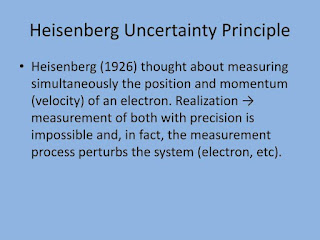
Not only that, you cannot simultaneously measure both the speed and position of any subatomic particle in motion accurately, and the more accurately you measure one, the more inaccurate the other.
Suddenly, science had to grapple with uncertainty. Lots and lots of it.This was a seismic shift in not just the world of science, but in philosophy and especially our understanding of the limits of knowledge.
We thought we knew everything about how the world worked until then, and people today are making the same mistake, and people tomorrow will make it too.
Electric car technology is cool and always improving, and has good applications in some situations, but before electric cars can be considered a true scalable solution for the mass market, several practical engineering and physical world issues remain to be resolved.
And he didn’t even get into the electricity generation part, which introduces other issues with cost and supply.
New technology can replace old technology of course — but it has to be better in some major way, rather than more expensive, less energy dense, and less practical.