I’ve always been fascinated by the process of building tunnels …
Immersed tube is what it sounds like: constructing sections above ground that are then immersed and connected together.
I’ve always been fascinated by the process of building tunnels …
Immersed tube is what it sounds like: constructing sections above ground that are then immersed and connected together.
The Great Slave Lake in Canada, in the Northwest Territories, is over 2,000 feet deep, deepest in North America.
I have never heard of it. Learn something new every day!
And yes, the name seems a little odd but it’s named after a family named “Slavey”. Also kinda odd, but then lots of names are odd when you really think about it …
I’ve always wondered about this… obviously the short answer is “because they adapt to the northern habitat better than deciduous trees”, but why is that, exactly?
A good short intro on the differences between the two types.
More nerdy details in this one.
Conifers are cone-bearing seed plants …
The great majority are trees, though a few are shrubs. Examples include cedars, Douglas-firs, cypresses, firs, junipers, kauri, larches, pines, hemlocks, redwoods, spruces, and yews. [...]
Although the total number of species is relatively small, conifers are ecologically important. They are the dominant plants over large areas of land, most notably the taiga of the Northern Hemisphere, but also in similar cool climates in mountains further south. Boreal conifers have many wintertime adaptations. The narrow conical shape of northern conifers, and their downward-drooping limbs, help them shed snow. Many of them seasonally alter their biochemistry to make them more resistant to freezing. While tropical rainforests have more biodiversity and turnover, the immense conifer forests of the world represent the largest terrestrial carbon sink. Conifers are of great economic value for softwood lumber and paper production.
In the fields of horticulture and botany, the term deciduous means "falling off at maturity"and "tending to fall off", in reference to trees and shrubs that seasonally shed leaves, usually in the autumn; to the shedding of petals, after flowering; and to the shedding of ripe fruit. The antonym of deciduous in the botanical sense is evergreen.
Generally, the term "deciduous" means "the dropping of a part that is no longer needed or useful" and the "falling away after its purpose is finished". In plants, it is the result of natural processes. "Deciduous" has a similar meaning when referring to animal parts, such as deciduous antlers in deer, deciduous teeth (baby teeth) in some mammals (including humans); or decidua, the uterine lining that sheds off after birth.
Deserts, Rainforest, Mountains, Volcanos … The List Goes On and On
Ancient Incan cities too. And terraces for farming on mountainsides. Nazca lines in the desert.
Something for everyone!
March 1, 1872
First explored by John Colter starting in 1807, on his return trip from the Lewis and Clark Expedition.
He is considered the first “mountain man” and so by definition he led quite the adventurous life, establishing trade with several Indian tribes and escaping an attack by the Blackfeet tribe by running naked and bloodied through the wilderness until his lone pursuer nearly caught him, only to be killed by Colter (later known as “Colter’s Run” in a retelling by Washington Irving and others).
When he finally returned to St. Louis in 1810 he told tales of steam rising from the Earth — describing geysers — which many people of course did not believe, coining the derisive term “Colter’s Hell” to describe it.
The area would remain largely untouched and un-explored until 1871:
The key to Yellowstone’s future as a national park, though, was the 1871 exploration under the direction of the government geologist Ferdinand Hayden. Hayden brought along William Jackson, a pioneering photographer, and Thomas Moran, a brilliant landscape artist, to make a visual record of the expedition. Their images provided the first visual proof of Yellowstone’s wonders and caught the attention of the U.S. Congress.
Within months it was declared the first national park.
A 45 minute National Geographic video:
Discovered via Archaeology & Art — Twitter is actually good for something if you use it right — with this amazing photo.

They carved it out of a mountain.
2100 years ago — at least — by hand.
The Nabataeans were nomadic Arabs who not only carved amazing buildings and art from solid rock, but created a luscious green oasis in a desert by mastering rainwater retention.
They specifically chose this location because it was a natural fortress with only small openings through the mountainous desert terrain, and because it was on an incense trade route.
And so it became a prosperous city, carved out of the mountains.
They carved this out of a mountain too.

More
How Wells and Aquifers Actually Work
Near failure of Oroville Dam in 2017 — I remember hearing about it and watching video of the spillway falling apart.
Did you know that inconceivably large salt mines exist underneath Lake Michigan and Lake Huron containing trillions of tons of salt?
Neither did I.
Learn about that and more: “The Creation of the Great Lakes”
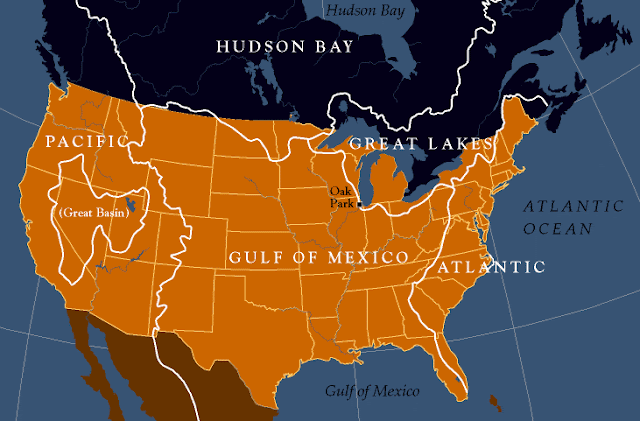
Related, from 2008 on my old Wordpress site: “From the Shores of Ancient Lake Chicago”. Did you know there are multiple Continental Divides in the U.S., and one of them runs through the Chicago area, delineating the boundary between runoff that ends up in the Great Lakes and runoff that ends up in the Mississippi River? It runs right through Oak Park, Illinois, where I lived in for over 10 years — never once did I hear about that while living there.